
16.11.2026 · Sustainability, Business Insights
Is solar PV still profitable? Why property owners need to act now
Since 2026, the remuneration for solar power fed into the grid has been linked to the market price. Precisely when PV systems produce the most, electricity is worth the least. From now on, the profitability of solar power depends on how much electricity is used, stored and marketed on site.
More electricity does not mean more revenue
Many PV systems on apartment buildings and commercial properties were built on a simple calculation: whatever is not consumed in the building is fed into the grid and remunerated. That calculation is adding up less and less. Since 1 January 2026, feed-in remuneration has been based on the quarterly average market price (Swissolar / pv magazine, 2026). For larger systems with self-consumption, the minimum remuneration falls to as little as 1.2 ct/kWh, depending on output (EKZ, 2026).
Electricity is worth least when the sun is shining
In the first quarter of 2026, the reference market price for solar power was CHF 117.66 per MWh. In the second quarter, with around three times as much production, it was just CHF 53.96 per MWh (SFOE, 2026). Volume rises, value falls. On top of this come negative electricity prices: in 2024, Switzerland already recorded 292 such hours, around four times more than in previous years (SRF, 2025). They almost always occur around midday on sunny days – exactly when PV systems feed the most power into the grid. In addition, grid operators may now curtail up to 3% of annual production (Swissolar / pv magazine, 2026).
Seasonal distribution is particularly relevant: around 70–75% of a PV system’s annual output is generated between April and September – in other words, in the summer half-year, when market prices are low.
What this means in practice
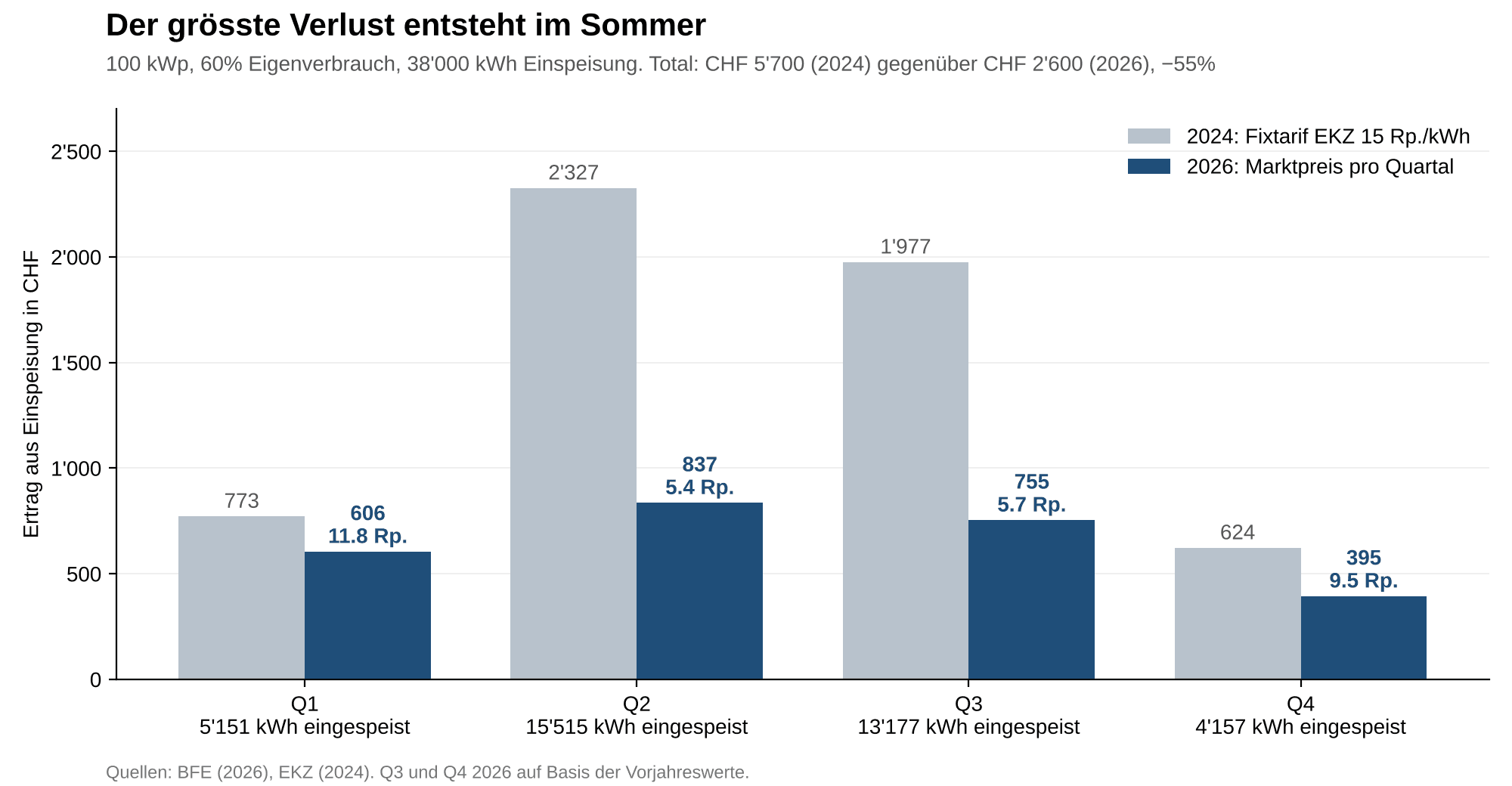
An example illustrates the impact: a 100 kWp system on the Swiss Plateau produces around 95,000 kWh per year. With 60% self-consumption, 38,000 kWh are fed into the grid. As around three-quarters of this is fed in during the summer half-year, when the market price is low, revenue falls by more than half (SFOE, 2026; EKZ, 2024).
| 2024 | 2026 | |
|---|---|---|
| Remuneration model | EKZ fixed tariff | Quarterly market price |
| Volume fed in | 38,000 kWh | 38,000 kWh |
| Remuneration | 15.0 ct/kWh | Ø 6.8 ct/kWh |
| Annual revenue | CHF 5,700 | CHF 2,600 (−55%) |
For larger systems, remuneration is often even lower. The minimum remuneration decreases as output rises and no longer applies at all from 150 kWp. In addition, for systems of 100 kW or more with self-consumption, EKZ caps total remuneration, including guarantees of origin, at 7.20 ct/kWh (EKZ, 2026). The 6.8 ct/kWh is therefore at the upper end of the range.
Self-consumption is not affected by this development. Every kilowatt-hour used on site replaces grid electricity, including grid usage charges and levies, and is therefore worth several times as much. With dynamic electricity tariffs, the cost of drawing power from the grid also varies with the time of day. From today’s perspective, business cases based on fixed feed-in remuneration over 25 years are too optimistic.
Measures owners should consider
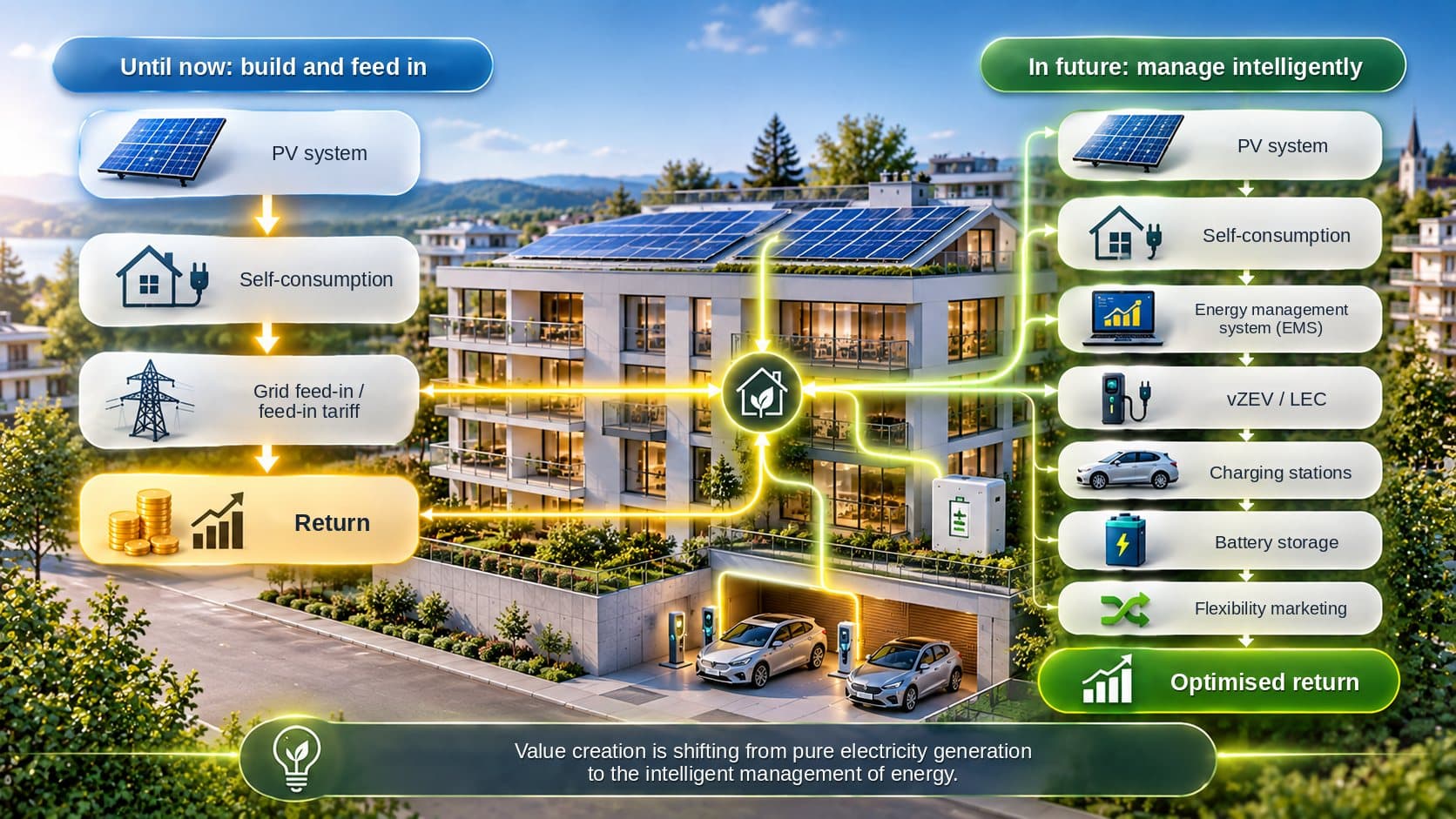
Self-consumption and EMS: an energy management system (EMS) controls heat pumps, water heaters and charging stations so that they run when the PV system is producing. In existing systems, this can often be retrofitted with little effort.
vZEV and LEC: in a virtual self-consumption community (vZEV), solar power is sold to tenants without the need for new cabling. Since 2026, local electricity communities (LECs) have made it possible to sell power within the neighbourhood, with a 40% discount on grid usage charges, or 20% where several grid levels are involved (Swissolar / pv magazine, 2026).
E-mobility: charging stations are large, easily controllable consumers. Shifting charging to the midday hours significantly increases self-consumption.
Battery storage: a battery shifts solar power into the evening. It usually only becomes economically viable when it performs several tasks, such as self-consumption, peak shaving, balancing energy or arbitrage.
Monetising flexibility: batteries, heat pumps and charging stations can be pooled via a platform and deployed on the balancing energy market. This opens up an attractive additional source of return.
Returns are generated by the system
In future, what will matter is less maximum production and more the ability to use electricity on site, store it and manage it economically. Tomorrow’s returns will not come from the solar system alone, but from the intelligent interplay of generation, consumption, storage and marketing.
We recommend that owners review their systems now: what is the self-consumption rate, which consumers can be controlled, and is a vZEV or an LEC an option? For new systems, these questions should be part of the planning from the outset.
With New Energy Solutions (NES), Wincasa supports property owners in analysing, planning and implementing such measures – from potential analysis through to operation.
About the author
Matthias Schmid is responsible for New Energy Solutions at Wincasa, focusing on e-mobility and photovoltaics in the real estate context. Together with his team, he identifies revenue risks for new and existing PV systems and supports property owners in optimising self-consumption and in implementing and operating holistic energy management solutions.

Sources
- SFOE (2026): Referenz-Marktpreise für die gleitende Marktprämie gemäss Art. 30aquinquies EnFV, Swiss Federal Office of Energy, Bern, 14 July 2026.
- EKZ (2026): Rückliefertarife 2026, Elektrizitätswerke des Kantons Zürich.
- Swissolar / pv magazine (2026): Swissolar veröffentlicht Neuregelungen für Photovoltaik-Anlagen 2026 auf einen Blick, pv magazine, 12 January 2026.
- SRF (2025): Absurdität in Energiebranche: Wenn der Strom plötzlich nichts mehr wert ist, 3 February 2025.
- top agrar (2025): Börsenstrompreis im Jahr 2025 schon 457 Stunden negativ, neuer Rekord.
- SFOE (2026): Referenz-Marktpreise Photovoltaik 2023 bis 2025, Swiss Federal Office of Energy, Bern, 9 March 2026.
- EKZ (2024): Rückliefertarife 2024, Elektrizitätswerke des Kantons Zürich.